
The Japan Rail Pass used to be an easy yes for many first-time visitors. After the major price increase, that is no longer true. In 2026, the real question is not simply “should I buy a JR Pass?” but whether your exact route, travel pace, and train choices make the maths work.
This Japan Rail Pass guide breaks down when the national pass still makes sense, when regional rail passes in Japan offer better value, and how to use a JR pass calculator without overestimating savings. If you are planning a classic Tokyo-Kyoto-Osaka trip, adding long-distance day trips, or building a multi-city itinerary, this guide will help you compare costs in a practical way. If you are still mapping out your broader trip, start with Japan Travel Guide for First Timers: Everything You Need to Know for timing, budget, and route planning basics.

Quick Answer: Is the JR Pass Worth It in 2026?
For many travellers, the Japan Rail Pass is no longer the automatic money-saver it used to be.
In 2026, the nationwide JR Pass can still be worth it if you are taking several long-distance Shinkansen journeys within a short period. However, for popular first-time routes like Tokyo, Kyoto and Osaka, it is usually cheaper to buy individual train tickets or use a regional pass.
The JR Pass is most likely worth it if your itinerary includes places like Hiroshima, Fukuoka, Kanazawa, Sendai, Aomori, Hakodate or multiple cross-country Shinkansen trips.
It is usually not worth it for:
- Tokyo only
- Tokyo + Kyoto
- Tokyo + Kyoto + Osaka
- Osaka + Kyoto + Nara
- Short Kansai trips
- Slow travel where you stay several days in each city
If you are only doing a Tokyo → Kyoto return, the JR Pass is generally not worth it.
JR Pass Prices in 2026
The standard nationwide Japan Rail Pass is available for 7, 14 or 21 consecutive days.
Approximate prices are:
| JR Pass Type | Ordinary Car | Green Car |
|---|---|---|
| 7-day JR Pass | ¥50,000 | ¥70,000 |
| 14-day JR Pass | ¥80,000 | ¥110,000 |
| 21-day JR Pass | ¥100,000 | ¥140,000 |
Prices can change, so always check the official JR Pass website or an authorised seller before buying.
The key question is simple:
Will your JR train journeys cost more than the price of the pass?
If the answer is yes, the JR Pass may be worth it. If not, individual tickets or regional rail passes will usually save you more money.
What the Japan Rail Pass actually covers in 2026?
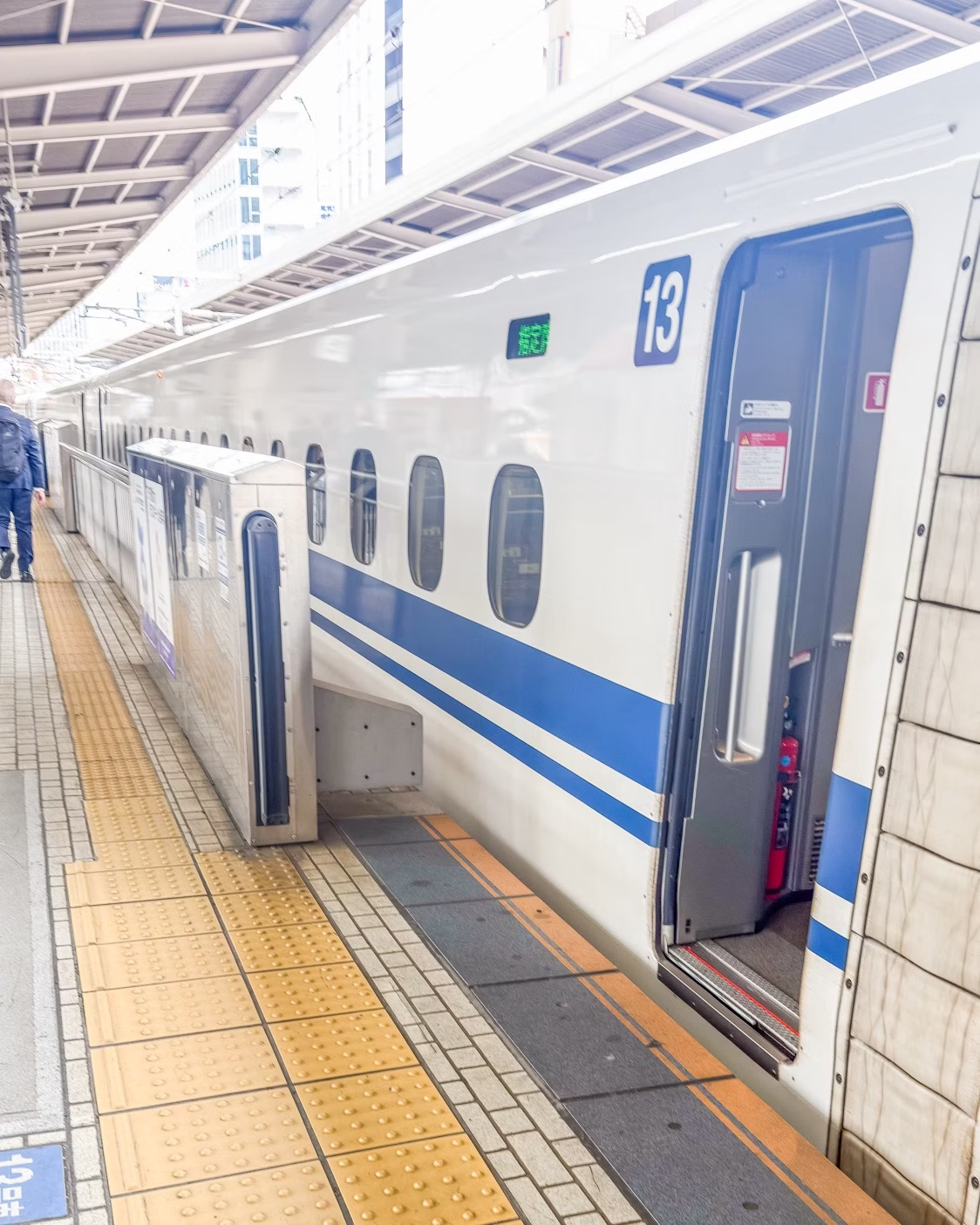
The national Japan Rail Pass gives unlimited travel for a fixed number of days on most JR-operated trains across the country, including many shinkansen routes, limited express trains, local JR lines, and some JR buses and ferries. It is sold in 7-day, 14-day, and 21-day versions, with ordinary and Green Car options. For many travellers, the biggest value comes from expensive long-distance bullet train journeys rather than city transport, because local subway and non-JR rides are usually not included.
The most important limitation is that the pass does not cover every train you may want. Nozomi and Mizuho services on the Tokaido, Sanyo, and Kyushu shinkansen are generally excluded unless you pay a supplementary charge under current rules, so pass holders often use Hikari, Sakura, or Kodama alternatives instead. That can mean slightly longer travel times, which matters if you are trying to fit in fast-paced itineraries. It also does not cover private railways, many metro systems, and airport transfer options outside JR networks.
he nationwide JR Pass covers a huge amount of transport across Japan, including:
- JR Shinkansen bullet trains
- Most JR limited express trains
- JR local and rapid trains
- Tokyo JR lines, including the Yamanote Line
- Osaka Loop Line
- JR trains to Kyoto, Nara, Kobe and Hiroshima
- Narita Express between Narita Airport and Tokyo
- Haruka Express between Kansai Airport and Osaka/Kyoto
- JR ferry to Miyajima
- Some JR buses
It is especially useful for travellers who are moving across several regions of Japan.
What Is Not Covered by the JR Pass?
The JR Pass does not cover everything.
It usually does not cover:
- Tokyo Metro
- Toei Subway
- Osaka Metro
- Kyoto buses and subway
- Private railway companies
- Most airport buses
- Highway buses
- Hakone private trains and ropeways
- Many city buses
- Some special sightseeing trains
The JR Pass also has rules around the fastest Shinkansen services. Traditionally, the pass did not fully cover Nozomi and Mizuho trains, which are the fastest services on some major routes. In recent years, pass holders have been able to use some of these trains by paying an additional supplement, but the rules and fees depend on the route.
For most visitors, the important point is this:
You can travel between Tokyo, Kyoto, Osaka and Hiroshima with the JR Pass, but you may need to choose eligible Shinkansen services or pay extra for the fastest trains.
Is the JR Pass worth it after the price increase?
For most travellers doing one standard Golden Route itinerary, the answer is often no. A return-style route such as Tokyo to Kyoto, Kyoto to Osaka, and Osaka back to Tokyo usually comes close to the cost of a 7-day pass, but not always enough to create meaningful savings. If you add only short regional trips in between, buying individual tickets can be simpler and sometimes cheaper, especially if you want the fastest Nozomi trains without restrictions.
Where the JR Pass still becomes attractive is on dense long-distance travel. Think Tokyo to Kanazawa, then Kyoto, then Hiroshima, then back to Tokyo within one week. Or a two-week trip that includes Hokkaido, Kansai, and Kyushu with multiple intercity journeys. In those cases, a national pass can still beat point-to-point tickets, while also giving flexibility to hop on additional JR routes without recalculating every fare. The pass is strongest when you are covering serious distance, not when you are staying several nights in just two or three cities.
- Usually worth checking carefully: 7 days with 3 or more expensive shinkansen legs
- Often not worth it: Tokyo, Kyoto, and Osaka only, with long stays in each city
- Better value cases: itineraries adding Hiroshima, Himeji, Kanazawa, Nagano, or Kyushu
- Best for flexibility: travellers taking extra spontaneous JR day trips
- Less useful for: city-heavy trips relying on subways, private railways, and local buses

How to use a JR pass calculator the right way
A JR pass calculator is useful, but only if you enter your route realistically. Many travellers overstate the value of the pass by adding every possible train they might take, including local metro rides, non-JR trains, or airport transfers that are not actually covered. The best approach is to list your confirmed long-distance journeys first, then add likely JR day trips. Compare that total with the cost of the pass for the exact validity period you would use.
When using any jr pass calculator, check four things:
- whether the route uses JR or private rail,
- whether you are comparing reserved or unreserved seats,
- whether your preferred train is Nozomi or Hikari,
- and whether the pass days line up with your expensive travel days.
A common mistake is activating a 7-day pass too early, then spending half of it on low-cost city travel. You usually want to start the pass on the first expensive intercity day, not on your arrival day unless that airport transfer is unusually costly.
- Enter only journeys you are very likely to take
- Separate long-distance shinkansen trips from cheap local rides
- Check if your route uses non-JR operators in places like Hakone, Koyasan, or parts of Nikko
- Compare the pass against the fastest train you would actually book without a pass
- Line up pass validity with your most expensive travel window
- Factor in convenience, not just the final yen total
Tokyo → Kyoto Return: Is the JR Pass Worth It?
This is one of the most common Japan travel questions.
Short answer: No, usually not.
A typical return journey between Tokyo and Kyoto costs roughly ¥28,000 to ¥30,000 using individual Shinkansen tickets.
The 7-day JR Pass costs around ¥50,000.
That means a simple Tokyo to Kyoto return does not come close to breaking even.
| Route | Approximate Cost |
|---|---|
| Tokyo → Kyoto | ¥14,000–¥15,000 |
| Kyoto → Tokyo | ¥14,000–¥15,000 |
| Total | ¥28,000–¥30,000 |
| 7-day JR Pass | ¥50,000 |
Verdict
For a Tokyo → Kyoto return, do not buy the nationwide JR Pass unless you are adding more expensive long-distance trips within the same 7-day period.
Better options include:
- Buying individual Shinkansen tickets
- Using an IC card for local travel
- Booking discounted train tickets where available
- Considering flights only if travelling much farther than Kyoto or Osaka
Tokyo → Kyoto → Osaka: Do You Need a JR Pass?
For most first-time visitors, this is the classic Japan route:
Tokyo → Kyoto → Osaka
In 2026, the nationwide JR Pass is usually not worth it for this itinerary.
Why? Because Kyoto and Osaka are very close to each other. The journey between Kyoto and Osaka is cheap compared with long-distance Shinkansen travel.
Approximate costs:
| Route | Approximate Cost |
|---|---|
| Tokyo → Kyoto | ¥14,000–¥15,000 |
| Kyoto → Osaka | ¥600–¥3,000 depending on train |
| Osaka local travel | Usually better with IC card |
| Total | Often under ¥20,000 |
Even if you return from Osaka to Tokyo, the total is usually around ¥30,000 to ¥35,000, still below the price of a 7-day JR Pass.
Verdict
For Tokyo, Kyoto and Osaka only, skip the nationwide JR Pass.
Use:
- Individual Shinkansen tickets
- Suica, Pasmo or Icoca for local trains
- Regional passes if you add Nara, Kobe, Himeji or Wakayama
Tokyo → Osaka → Hiroshima: Is the JR Pass Worth It?
This route is more interesting because Hiroshima is far enough from Tokyo and Osaka to make the JR Pass worth considering.
A common route is:
Tokyo → Osaka → Hiroshima
If you end your trip in Hiroshima, the JR Pass is usually not worth it because you are only travelling one way across the country.
Approximate costs:
| Route | Approximate Cost |
|---|---|
| Tokyo → Osaka | ¥14,000–¥15,000 |
| Osaka → Hiroshima | ¥10,000–¥11,500 |
| Total | Around ¥25,000–¥27,000 |
That is far below the 7-day JR Pass price.
However, if your route is:
Tokyo → Osaka → Hiroshima → Tokyo
then the calculation changes.
| Route | Approximate Cost |
|---|---|
| Tokyo → Osaka | ¥14,000–¥15,000 |
| Osaka → Hiroshima | ¥10,000–¥11,500 |
| Hiroshima → Tokyo | ¥19,000–¥21,000 |
| Total | Around ¥43,000–¥47,500 |
This is still slightly below the 7-day JR Pass price in many cases, but it gets close. If you add side trips such as Himeji, Miyajima, Nara or Kobe, the JR Pass may become more useful.
Verdict
For Tokyo → Osaka → Hiroshima only, the JR Pass is usually not worth it.
For Tokyo → Osaka → Hiroshima → Tokyo, it is close, but not always a clear saving. Compare your exact route before buying.
A better option may be a regional JR West pass, especially if you are spending most of your time around Osaka, Hiroshima and western Japan.
Sample itineraries: when the national JR Pass does and does not pay off
The easiest way to judge whether the japan rail pass is worth it is to test it against real itineraries. A classic first trip with four nights in Tokyo, three in Kyoto, and two in Osaka often does not need the national pass. You might use the shinkansen only from Tokyo to Kyoto and later from Osaka back to Tokyo, while most city transport happens on metros or private lines. In that scenario, individual tickets usually keep things simple and can cost less.
By contrast, a faster-moving route like Tokyo-Nagano-Kanazawa-Kyoto-Hiroshima-Osaka within 7 days can swing strongly in favour of the pass. The same goes for travellers using Hiroshima as a base for Miyajima, or adding Himeji on the way west. If your trip includes several long sectors close together, the pass can turn from marginal to excellent value very quickly. This is especially true if you like keeping plans flexible rather than locking every ticket in advance.
| Itinerary style | National JR Pass value | Why |
|---|---|---|
| Tokyo + Kyoto + Osaka only | Usually low | Too few expensive JR journeys; city travel often not covered |
| Tokyo + Kyoto + Hiroshima + Osaka | Often good | Hiroshima adds a costly long-distance leg |
| Tokyo + Kanazawa + Kyoto + Hiroshima + Tokyo | Often high | Multiple expensive intercity sectors inside one week |
| Kansai-only trip | Poor | Regional passes are usually better value |
| Kyushu or Hokkaido-focused trip | Mixed | Regional JR passes can outperform the national pass |

When the JR Pass Is Still Worth It in 2026
The JR Pass can still be worth it if you travel long distances quickly.
It is most useful for routes like:
- Tokyo → Kyoto → Hiroshima → Tokyo
- Tokyo → Osaka → Hiroshima → Fukuoka → Tokyo
- Tokyo → Kanazawa → Kyoto → Hiroshima → Tokyo
- Tokyo → Sendai → Aomori → Hakodate → Tokyo
- Tokyo → Kyoto → Hiroshima plus several major day trips
The JR Pass works best when you are doing at least two or three expensive long-distance Shinkansen journeys within the pass period.
A good rule:
The 7-day JR Pass becomes worth considering when your train costs exceed ¥50,000.
When the JR Pass Is Not Worth It
The JR Pass is usually not worth it if your trip is slow, local or focused on one region.
You probably do not need the nationwide JR Pass for:
- 5 days in Tokyo
- Tokyo and Kyoto only
- Tokyo, Kyoto and Osaka only
- Osaka, Kyoto and Nara
- A Kansai-only itinerary
- A Kyushu-only itinerary
- A Hokkaido-only itinerary
- A trip where you fly into Tokyo and out of Osaka
- A trip where you only take one Shinkansen
For these trips, regional passes or individual tickets usually make more sense.
7-Day JR Pass: Best Use Cases
The 7-day JR Pass is the easiest version to make worthwhile because it has the lowest break-even point.
It can be worth it if you pack your expensive train travel into one week.
Example 1: Tokyo, Kyoto, Hiroshima and back to Tokyo
| Route | Approximate Cost |
|---|---|
| Tokyo → Kyoto | ¥14,000–¥15,000 |
| Kyoto → Hiroshima | ¥11,000–¥12,000 |
| Hiroshima → Tokyo | ¥19,000–¥21,000 |
| Side trips/local JR travel | ¥2,000–¥5,000 |
| Total | Around ¥46,000–¥53,000 |
This is close to the 7-day JR Pass price. If you add Miyajima, Himeji or extra JR travel, the pass may be worth it.
Example 2: Tokyo, Kanazawa, Kyoto, Hiroshima and Tokyo
This route can make better use of the JR Pass because it covers more ground.
Possible route:
Tokyo → Kanazawa → Kyoto → Hiroshima → Tokyo
This is the kind of itinerary where the 7-day JR Pass may start to make sense, especially if you travel efficiently.
14-Day JR Pass: Is It Worth It?
The 14-day JR Pass is harder to justify than the 7-day pass.
At around ¥80,000, you need a lot of long-distance train travel to break even.
For many two-week Japan itineraries, individual tickets are cheaper.
Example: 14-Day Itinerary Where the JR Pass Is Usually Not Worth It
A common first-time Japan itinerary:
- Days 1–4: Tokyo
- Days 5–7: Kyoto
- Days 8–10: Osaka
- Days 11–12: Hiroshima and Miyajima
- Days 13–14: Tokyo
Route:
Tokyo → Kyoto → Osaka → Hiroshima → Tokyo
Approximate train cost:
| Route | Approximate Cost |
|---|---|
| Tokyo → Kyoto | ¥14,000–¥15,000 |
| Kyoto → Osaka | Under ¥3,000 |
| Osaka → Hiroshima | ¥10,000–¥11,500 |
| Hiroshima → Tokyo | ¥19,000–¥21,000 |
| Total | Around ¥45,000–¥50,000 |
The 14-day JR Pass costs around ¥80,000, so this itinerary usually does not justify it.
For this trip, it may be better to buy individual Shinkansen tickets and use local IC cards.
Example: 14-Day Itinerary Where the JR Pass Could Be Worth It
The 14-day JR Pass can work if your trip includes both western and northern Japan, or several long-distance returns.
Example:
- Days 1–3: Tokyo
- Days 4–5: Sendai or Aomori
- Days 6–7: Hakodate
- Days 8–10: Kyoto
- Days 11–12: Hiroshima
- Days 13–14: Return to Tokyo
This type of itinerary includes expensive travel across multiple regions. In that case, the 14-day JR Pass may be worth comparing carefully.
Verdict on the 14-Day JR Pass
The 14-day JR Pass is best for travellers covering a lot of Japan in one trip.
It is usually not worth it for a simple two-week route like:
Tokyo → Kyoto → Osaka → Hiroshima → Tokyo
For most visitors, a better strategy is to buy a 7-day JR Pass only for the busiest travel week, or skip the nationwide pass completely and use regional passes.
Why regional rail passes in Japan are often the smarter buy

For many 2026 itineraries, regional rail passes Japan offers are better value than the nationwide pass. These passes are designed for travellers staying within one area, such as Kansai, Kansai-Hiroshima, Kyushu, Hokkaido, or the Japanese Alps. They usually cost much less than the national JR Pass and can still cover the exact trains you need. If your trip is built around Osaka, Kyoto, Nara, Kobe, and maybe Hiroshima, a regional pass often wins on price.
This matters because many visitors now spend longer in one region rather than racing across the whole country. For example, if you want to base yourself in Tokyo and explore city neighbourhoods, food, and seasonal events, your money may be better spent on local transport and attractions instead. Our guides to 20 Best Things to Do in Tokyo, Japan and 15 Most Instagrammable Places in Tokyo, Japan show just how much of a Tokyo trip happens off the JR long-distance network.
- Kansai Area passes: useful for Kyoto, Osaka, Nara, Kobe, and nearby cities
- Kansai-Hiroshima passes: strong value if you want Hiroshima without buying a national pass
- JR Kyushu passes: often excellent for Fukuoka, Kumamoto, Beppu, Yufuin, and Kagoshima routes
- Hokkaido passes: best for longer distances between Sapporo, Hakodate, Asahikawa, and beyond
- Alpine or Hokuriku-focused passes: useful for Nagano, Matsumoto, Toyama, and Kanazawa itineraries
Regional Passes That Can Save More Money
In 2026, regional JR passes are often better value than the nationwide JR Pass.
If your itinerary focuses on one part of Japan, check regional passes first.
1. Kansai-Hiroshima Area Pass
Best for:
- Osaka
- Kyoto
- Kobe
- Himeji
- Okayama
- Hiroshima
- Miyajima
This is one of the best-value passes for travellers visiting western Japan.
It can be a great option if you are doing:
Osaka → Hiroshima → Miyajima → Himeji → Osaka
For many travellers, this pass saves more money than the nationwide JR Pass because it covers the expensive Osaka to Hiroshima route at a much lower price.
Good for:
- Osaka-based trips
- Kyoto + Hiroshima itineraries
- Miyajima day trips
- Himeji Castle
- Travellers flying into Kansai Airport
2. Kansai Wide Area Pass
Best for:
- Osaka
- Kyoto
- Nara
- Kobe
- Himeji
- Okayama
- Wakayama
- Kinosaki Onsen
This pass is useful if you are staying in Kansai and want to explore beyond Kyoto and Osaka.
It can be better than the nationwide JR Pass for travellers who are not going all the way back to Tokyo.
3. Hokuriku Arch Pass
Best for:
- Tokyo
- Nagano
- Kanazawa
- Fukui
- Kyoto
- Osaka
This pass connects Tokyo and Osaka/Kyoto through the Hokuriku region rather than the direct Tokaido Shinkansen route.
It is slower than going directly from Tokyo to Kyoto, but it can be good if you want to visit:
- Kanazawa
- Nagano
- Toyama
- Fukui
- The Japanese Alps region
Best for travellers who want a scenic route rather than the fastest route.
4. JR East Pass
Best for:
- Tokyo
- Nikko
- Sendai
- Aomori
- Nagano
- Niigata
- Tohoku region
The JR East Pass can offer strong value if you are exploring northern Honshu.
It is especially useful for:
- Tohoku itineraries
- Ski trips
- Onsen towns
- Cherry blossom trips in northern Japan
- Autumn foliage routes
If you are not going to Kyoto or Osaka, this may be much better than the nationwide JR Pass.
5. Tokyo Wide Pass
Best for short trips from Tokyo.
Useful for:
- Nikko
- Karuizawa
- Mount Fuji area
- Izu Peninsula
- Kusatsu Onsen
- Gala Yuzawa
This is a good pass for travellers staying in Tokyo but taking several day trips.
It is much cheaper than the nationwide JR Pass and often better suited to short stays.
6. JR Kyushu Pass
Best for:
- Fukuoka
- Nagasaki
- Kumamoto
- Beppu
- Kagoshima
- Aso
If your trip is focused on Kyushu, do not buy the nationwide JR Pass without comparing the JR Kyushu Pass first.
Kyushu has excellent trains and many great destinations, so a regional pass can be very useful.
7. JR Hokkaido Pass
Best for:
- Sapporo
- Hakodate
- Asahikawa
- Furano
- Biei
- Noboribetsu
- Abashiri
Hokkaido is large, and train distances can be long. If you are exploring Hokkaido by rail, a JR Hokkaido Pass may save more than the nationwide pass.
However, for remote areas, a rental car may still be more practical.
JR Pass vs Regional Pass: Which Should You Choose?
Use this simple rule:
| Your Trip Type | Best Option |
|---|---|
| Tokyo only | IC card |
| Tokyo + Kyoto return | Individual Shinkansen tickets |
| Tokyo + Kyoto + Osaka | Individual tickets |
| Osaka + Kyoto + Nara | IC card or local passes |
| Osaka + Hiroshima + Miyajima | Kansai-Hiroshima Area Pass |
| Tokyo + Kanazawa + Kyoto/Osaka | Hokuriku Arch Pass |
| Tokyo + Tohoku | JR East Pass |
| Kyushu only | JR Kyushu Pass |
| Hokkaido only | JR Hokkaido Pass |
| Multiple regions across Japan | Nationwide JR Pass may be worth it |
When buying point-to-point tickets makes more sense?
Buying individual tickets is often the best option if your itinerary has only one or two major shinkansen rides. This gives you freedom to choose the fastest service, book exact train times, and avoid paying for unused pass days. It is especially sensible on trips where you fly into Tokyo and out of Osaka, or vice versa, because you remove the expensive return leg that often made the old JR Pass worthwhile.
Point-to-point tickets also work well if you are mixing rail with flights, buses, or private railway routes. Many popular side trips rely on non-JR transport, so a pass does not help much. If your plan includes temple visits, food districts, and city-based sightseeing rather than constant rail movement, a simple ticket-by-ticket approach is usually more efficient. For example, if you are heading to Tokyo mainly for dining, neighbourhood wandering, and markets, our 17 Best Restaurants in Tokyo Japan: Must-Visit Food Spots guide shows how little of that experience depends on a national rail pass.
Best Alternatives to the JR Pass
If the JR Pass does not make sense for your itinerary, do not worry. Japan is still easy to travel around.
Good alternatives include:
1. Individual Shinkansen Tickets
Best for simple routes like:
- Tokyo → Kyoto
- Tokyo → Osaka
- Kyoto → Hiroshima
- Osaka → Hiroshima
This is usually the best option for first-time visitors doing a classic route.
2. IC Cards
Use an IC card for local travel.
Popular cards include:
- Suica
- Pasmo
- Icoca
They work on most local trains, buses, convenience stores and vending machines.
3. Regional Rail Passes
Often better for specific areas, especially:
- Kansai
- Hiroshima
- Kyushu
- Hokkaido
- Tohoku
- Hokuriku
4. Domestic Flights
Flights can be cheaper for very long distances, especially:
- Tokyo → Sapporo
- Tokyo → Fukuoka
- Tokyo → Okinawa
However, factor in airport transfer time and baggage costs.
5. Highway Buses
Highway buses are slower but much cheaper.
They can be useful for budget travellers travelling overnight between major cities.
JR Pass Break-Even Examples
Here are simple examples to help decide whether the JR Pass is worth it.
| Itinerary | JR Pass Worth It? | Why |
|---|---|---|
| Tokyo only | No | Local travel is cheap |
| Tokyo → Kyoto return | No | Costs far less than 7-day pass |
| Tokyo → Kyoto → Osaka | No | Osaka is close to Kyoto |
| Tokyo → Osaka → Hiroshima | Usually no | One-way route is not enough |
| Tokyo → Osaka → Hiroshima → Tokyo | Maybe | Close, but compare carefully |
| Tokyo → Kyoto → Hiroshima → Tokyo | Maybe | Can be close to break-even |
| Osaka → Hiroshima → Miyajima → Osaka | Regional pass better | Kansai-Hiroshima pass often wins |
| Tokyo → Kanazawa → Kyoto → Hiroshima → Tokyo | Possibly | More long-distance travel |
| Tokyo + Tohoku + Hokkaido + Kyoto | Possibly yes | Multiple expensive routes |
| Kyushu-only trip | No | JR Kyushu Pass may be better |
How to Decide If You Should Buy the JR Pass
Before buying the JR Pass, write down every major train journey you plan to take.
Then check:
- Are you taking more than one long-distance Shinkansen?
- Are the journeys within 7, 14 or 21 consecutive days?
- Are you returning to Tokyo or travelling one way?
- Would a regional pass cover the expensive part of your trip?
- Are you mostly using JR trains or private railways?
- Is convenience worth paying extra for?
The JR Pass is not just about money. It can also be convenient because you do not need to buy separate tickets for every JR journey.
But in 2026, convenience alone may not justify the higher price for many travellers.
Practical tips before you buy any Japan train pass
Before paying for any japan train pass guide recommendation you see online, build your route day by day. Write down each overnight base, each intercity transfer, and each likely day trip. Then check which parts are JR, which are not, and whether your expensive journeys fall into a 7-day or 14-day window. This one step prevents most overbuying. It also helps you decide whether a national pass, regional pass, or plain tickets are the best fit.
Also think about pace. A pass can encourage over-scheduling because unlimited travel feels like value only if you keep moving. But Japan rewards slower travel too, especially in Kyoto, Tokyo, and Osaka. If you are visiting in spring, you may want to spend more time in seasonal spots such as 17 Best Cherry Blossom Spots in Kyoto Japan or 12 Best Osaka Cherry Blossom Spots in 2026 rather than squeezing in one more train ride just to justify a pass.
- Buy the pass only after your route is mostly fixed
- Activate it on your first expensive long-distance day, not automatically on arrival
- Reserve seats early during cherry blossom, Golden Week, Obon, and New Year periods
- Check airport routes separately, as not every airport transfer is fully covered
- Do not assume subways in Tokyo, Kyoto, or Osaka are included
- Keep a backup payment card for non-covered private rail segments

Final verdict: should you buy a JR Pass in 2026?
The JR Pass is no longer a default purchase for first-time visitors. In 2026, it is worth buying only if your itinerary includes enough expensive JR long-distance travel inside a short period. For many travellers, especially those doing Tokyo, Kyoto, and Osaka at a relaxed pace, point-to-point tickets or regional rail passes in Japan will offer better value and more flexibility.
If you are still unsure, use a jr pass calculator with your confirmed route, then compare that total against regional alternatives and individual tickets. Focus on your actual train days, not hypothetical ones. The best rail strategy in Japan is rarely the one with the biggest name; it is the one that matches how you really travel.
And once you are on the ground, remember that smooth train travel also depends on local etiquette, so it is worth reviewing 25 Do’s and Don’ts in Japan: Ultimate list of Japanese Etiquettes before you go.
For a simple Tokyo → Kyoto return, skip it.
For Tokyo → Osaka → Hiroshima, it depends on whether you return to Tokyo and add extra side trips.
For a typical 14-day itinerary covering Tokyo, Kyoto, Osaka and Hiroshima, the 14-day JR Pass is usually too expensive to justify.
The biggest savings in 2026 often come from:
- Individual Shinkansen tickets
- IC cards for local travel
- Regional JR passes
- Careful route planning
The best advice is this:
Do not buy the JR Pass first and plan around it. Plan your itinerary first, then see if the pass saves money.
For many visitors, especially first-timers, the smarter choice will be individual tickets plus a regional pass where needed.
Related guides
- Japan Travel Guide for First Timers: Everything You Need to Know
- 20 Best Things to Do in Tokyo, Japan
- 17 Best Cherry Blossom Spots in Kyoto Japan
FAQs: Japan Rail Pass Guide 2026
Is the JR Pass worth it for Tokyo to Kyoto return?
Usually, no. A Tokyo to Kyoto return is much cheaper than a 7-day JR Pass.
Is the JR Pass worth it for Tokyo, Kyoto and Osaka?
Usually not. Kyoto and Osaka are close together, so this route does not include enough expensive travel to justify the nationwide JR Pass.
Is the JR Pass worth it for Tokyo, Osaka and Hiroshima?
It depends. If you travel one way from Tokyo to Osaka to Hiroshima, usually no. If you return to Tokyo and add side trips, it may be close.
Is the 14-day JR Pass worth it?
Only for very travel-heavy itineraries. A normal two-week trip to Tokyo, Kyoto, Osaka and Hiroshima usually does not make the 14-day JR Pass worth it.
Which regional pass is best for Hiroshima?
The Kansai-Hiroshima Area Pass is often one of the best options if you are travelling from Osaka or Kyoto to Hiroshima and Miyajima.
What is the best alternative to the JR Pass?
For many travellers, the best alternative is a combination of individual Shinkansen tickets, an IC card and one regional rail pass if needed.
Should I buy the JR Pass before going to Japan?
Only buy it after checking your itinerary. If your major train journeys cost less than the pass, it is better to buy individual tickets.
Topics that may interest you

Must Eat Food in Japan: 25 Iconic Dishes, Street Foods & Markets Travellers Love
Japan Rail Pass Guide (2026): Is the JR Pass Still Worth It?

15 Most Instagrammable Places in Tokyo, Japan

PokePark Kanto Tokyo Review: Is It Worth Visiting?

Japan Travel Guide for First Timers: Everything You Need to Know

20 Best Things to Do in Tokyo, Japan

17 Best Restaurants in Tokyo Japan: Must-Visit Food Spots

25 Do’s and Don’ts in Japan: Ultimate list of Japanese Etiquettes

12 Best Osaka Cherry Blossom Spots in 2026


Leave a Reply